
ASEAN: What it is, who's in, and does it *actually* matter?
ASEAN's Grand Designs: Are They Building a Future or Just Another Bureaucratic Maze?
Let's be real. When someone tells you they've been "working on a vision since the 1990s," your bullshit detector should be screaming. That's exactly what's happening with this so-called ASEAN power grid. They're talking about a $750 billion project to connect ten ASEAN countries, promising cheap, reliable, green energy. Sounds great on paper, doesn't it? Like a shiny new Nvidia GPU for the entire region. But then you look at the facts.
Energy demand across Southeast Asia shot up twice the global average last year. It’s set to double by 2050. These countries, these `asean members`, they're pushing into energy-intensive industries, slapping up `data centres` like crazy. Meanwhile, they're sitting on 20 terawatts of potential renewable energy – that's 55 times what they're generating now! It’s like having a gold mine and still buying your gold from the guy next door. Why? Because `international` corporate bigwigs, according to EY-Parthenon, are too busy fretting about tariffs and `geopolitics` to actually fix the power problem. Give me a break. They're worried about `china` and `global` trade wars, not whether the lights stay on for the guy trying to run a small business in Vietnam. This ain't just a technical glitch; it's a monumental failure of priorities.
The Asian Development Bank and the `world` Bank are now throwing money at it – $10 billion here, $2.5 billion there. Grants, guarantees, technical assistance. Sounds like a classic bailout, doesn't it? Like throwing a new coat of paint on a house with a crumbling foundation. They've been talking about this since the 90s, and suddenly, in 2025, there's a "new financing initiative." What took them so long? `What is ASEAN`, really, if it can't even get its act together on something this fundamental?
The Grid That Wasn't (Yet)
The official line is "technical reasons." Different voltages, varying levels of sophistication, distinct operating standards. Oh, and "politics." `Countries in ASEAN` have "prioritized domestic industrial development and national energy policies." That's code for: "We couldn't agree on squat because everyone wanted to protect their own turf." It’s like trying to build a superhighway where every state insists on its own unique lane width and speed limit. You end up with a patchwork of dirt roads, not an `economic` super-corridor.
Now, all of a sudden, "increasing urgency around energy transition" has shifted those priorities. Funny `how` a crisis can do that, ain't it? They’re finally talking about undersea cables, like the one Malaysia, Singapore, and Vietnam are exploring for offshore wind. Vietnam wants to be a `renewable energy hub`, Singapore wants to import. Great. But this isn't just about connecting a few dots; it's about a widespread upgrade of national grids, digital tech integration, battery storage to handle intermittency. It's a massive undertaking, like trying to rebuild the internet from scratch, but with more concrete and less `AI`. You'd think after decades of talk, they'd have a `best` practice blueprint ready. Guess not.
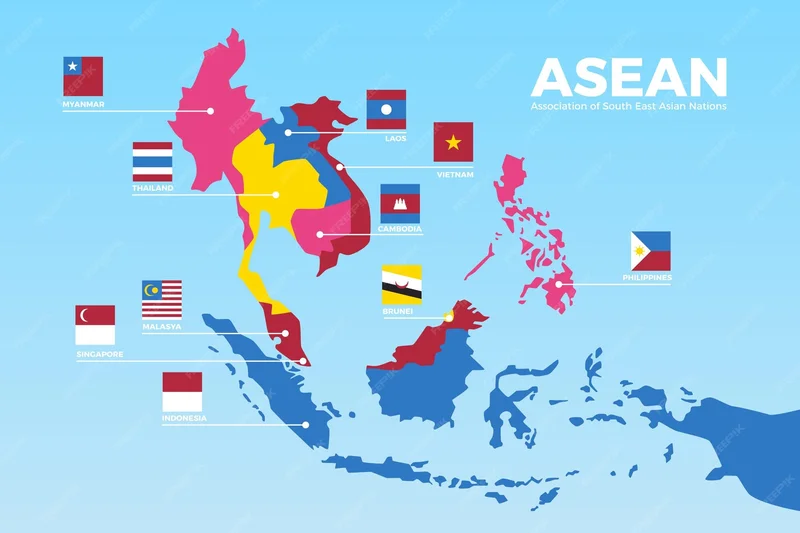
My gut tells me this whole thing is a fragile house of cards. They're talking about a `vision for an ASEAN power grid` that could triple capacity by 2040, connecting 780 million people. That's a huge promise. But `who` is going to ensure this actually gets done, on time and on budget? And when they talk about "climate-resilient food security" and "agritech" as long-term benefits, I can almost hear the buzzwords echoing in a stuffy conference room, the kind with bad coffee and even worse air conditioning. It sounds like a consultant's dream, not a concrete plan. Then again, maybe I'm just too cynical.
Diplomacy's Endless Loop and a New Kid on the Block
Speaking of endless loops, let's pivot to the `Myanmar crisis`. The Philippines is taking over the ASEAN chairmanship in 2026, and their new special envoy, Maria Theresa Lazaro, is promising "continuity." `What is asean countries` doing about Myanmar? Not much, apparently. "Continuity" in this context feels like a euphemism for "we're going to keep doing the bare minimum while 7,000 people are killed and 30,000 are imprisoned." The military junta controls less than half the country, yet ASEAN's "Five-Point Consensus" from 2021 remains their `main reference`. That's not a roadmap; it's a broken compass. They can't even agree to send observers to Myanmar's elections. Some `asean countries` are apparently too cozy with the junta or `china` to rock the boat. It's embarrassing, frankly. It shows a fundamental weakness at the heart of `asean meaning` – if you can't stand together on human rights, `what is asean` really for?
And then there's Timor-Leste, the `latest` member, the 11th country to join the club. They just immediately signed onto the Southeast Asia Nuclear Weapon-Free Zone (SEANWFZ) Treaty. This tiny nation, forged in conflict, steps up and says, "We stand for neutrality and peace!" Critics call the treaty "toothless" because the big nuclear powers won't sign its protocol. But Timor-Leste's move has a "profound political significance," according to the experts. It completes the "geographical closure" of the zone. Basically, the new kid on the block is doing more to assert ASEAN's core principles than some of the old guard. It's a stark contrast between a nation willing to make a formal commitment and the inability of long-standing `asean members` to honor political pledges like the Five-Point Consensus. It's like the new intern showing up on day one and outperforming the grizzled veterans who've been phoning it in for years. According to some, Timor-Leste is acting as Timor-Leste steps up as ASEAN’s new neutrality anchor.
The whole thing feels like a juggling act – a grand `economic` vision that might never materialize, a human rights crisis that `international` diplomacy seems powerless to address, and a new member trying to remind everyone `what is asean countries` is supposed to stand for.
The Cynic's View on Tomorrow
The geopolitics of oil webinar, buried in the input, just reinforces my skepticism about all these grand `global` plans. Carolyn Kissane, this NYU professor, drops truth bombs: the `world` consumes over 100 million barrels of oil a day, and demand ain't slowing down, especially in Asia. Russia's still selling its discounted crude to `china` and India, sanctions be damned. Western banks are telling Africa to go green while they still burn fossil fuels... it's a joke. `How` can `asean countries` truly commit to a green grid when the `global` energy landscape is such a mess, driven by raw power and self-interest? The "top three challenges" – US-Saudi tensions, US-China rivalry, tightening supply – mean everyone's fighting over scraps. The promise of a unified, green ASEAN feels like a distant dream when the world is still hooked on the black stuff, and `who` holds the power is still determined by who controls the spigot.
Another Day, Another Power Point
Honestly, all these "visions" and "initiatives" feel less like concrete plans and more like elaborate PowerPoint presentations designed to impress donors and distract from the real issues. They're talking about `digital technology` and `AI` for grid stability, but they can't even get past basic political squabbles for thirty years. It's a mess, and I don't see it getting untangled anytime soon.